This morning, Sony announced that in 2028 they will discontinue the production of PlayStation games on physical media. This is presumably part of the lead-in to the release of the PlayStation 6, which is rumored to exist as both a low-power handheld and a high-power home console. This news comes on the heels of Rockstar Games announcing that Grand Theft Auto 6 will release in digital form only – if you buy a box, it will contain a download code and that’s it. Sony’s announcement was followed by reporting from Windows Central that the upcoming XBOX successor code-named “Project Helix” may also drop disc support.
A lot of folks have written in various venues about why digital-only games are bad or harmful for this or that reason – access, preservation, economics – there are a million arguments. This post will highlight a concern I have that is often overlooked in these discussions: the effects on education and the classroom.
Right now, one of the largest hurdles that we have with students who want to get into games in some capacity is access. Before I taught in games, I worked in an English Literature department. We assigned specific readings for each class, the students read them [ideally], wrote about them, and discussed them. Students acquired these texts in one of two ways: either as scanned PDFs excerpted from longer works (which we as faculty can provide legally as part of the fair use education carve-out) or by purchase. The average course might cost around $30 in book materials as a result. Students could get books out of the library for free.
Last semester, I taught a humanities-style course on Game Writing and Narrative Design. This was a very popular course. It alternated between readings, games and hands-on scripting/programming tutorials. It is largely exploratory and introductory; the hope is that it will flow into a second semester that is closer to a creative writing workshop in structure. The general course content loop went like this:
Read a Text (usually a classic work of literature or theory) -> Play a Game (inspired by concepts in the older works) -> Learn a new Engine/Tool (Twine, Ink, Ren’Py)
Because games are art and exist within a cultural context, students need to understand where the games they like come from. In the English department, this was easy, because we knew that irrespective of a student’s high school background, they were coming in with some baseline knowledge. They had read a novel before. They knew what a poem was. They probably had read at least one Shakespeare play. And so forth.
In a games program, you can’t guarantee anything. Yes the students may love to play games, but they haven’t had a grounding in any sort of canonical works, they may not have heard of famous titles or even played things you might expect. Many students haven’t ever really touched the original Super Mario Bros., for example, even if the are aware of it. What this means is that this context-building is especially important because you’re building the groundwork that their entire understanding of the field needs to rest upon.
For context, here are the games that I assigned last semester, along with their current prices on Steam at time of posting this blog. We are in the middle of the Steam Summer Sale, so prices are pretty good, but come the school year this will not be the case for many titles. Games are divided into mandatory plays (which must be played to pass the class) and “Level-Ups” which students may optionally choose to play a few of if they want to finish with a higher grade:
Mandatory Games:
80 Days – Inkle, 2014 – $3.89 (Reg. $12.99)
Bioshock – 2K Games, 2007 – $4.99 (Reg. $19.99)
Dungeons & Dragons 5th Edition – Wizards of the Coast, 2014 – $29.99 (pdf from WotC)
Journey – thatgamestudio, 2012 – $3.74 (Reg. $14.99)
Return of the Obra Dinn – Lucas Pope, 2018 – $19.99
Victory Garden – Stewart Moulthrop, 1991 – $0 (free in browser! hooray!)
Planetarian: The Reverie of a Little Planet – Key, 2004 – $3.99 (Reg. $9.99)
Subtotal: $66.59 (Reg: $107.94)
Level-Ups
Disco Elysium – ZA/UM, 2019 – $3.99 (Reg. $39.99)
Final Fantasy VII Rebirth – Square Enix, 2024 – $19.99 (Reg. $49.99)
Her Story – Sam Barlow, 2015 – $4.99 (Reg. $9.99)
That Dragon, Cancer – Numinous Games, 2016 – $9.99
What Remains of Edith Finch – Giant Sparrow, 2017 – $4.99 (Reg. $19.99)
Subtotal: $43.95 (Reg: $129.95)
Grand Total: $ 110.54 (Reg. $237.89)
Now some caveats: these prices are all pre-tax, so the real totals are somewhat higher. Students do not need to purchase every “Level-Up” game, two or three for the semester is enough to get full credit. Some students own other platforms, like a Nintendo Switch, where they might grab a better deal occasionally. Some games will always be on sale at any time, so the “real” cost of the materials for this course will be between the supersale price and the regular price. So let’s say the average student is paying… oh, I don’t know, let’s peg it at $125 for the games this semester.
If you did a STEM major, you may be thinking something like “that’s not so bad, my chemistry textbook cost $300!” It sure did. But I bet you had options to buy that textbook used at a massive discount, or you could rent it from the school store for a fraction of the face price. Maybe an upperclassman let you borrow their copy. There were options.
This also does not include the cost of the hardware you need to run games – every student needs a gaming-capable laptop. And again, this is just one class! Most students are taking 4-5 courses a semester with comparable materials costs, whether it’s other games, software licensing fees for things like Adobe Creative Cloud or Toon Boom Harmony, or other costs. This is financially unsustainable for most of my students. They’ve already taken out massive loans to simply be in the classroom, and now there are hundreds of dollars in software fees being dumped on them.
So what can be done? Well, a few things, historically.
For years, I have run a lending library for students in my program. There is a spreadsheet with hundreds (thousands? I haven’t counted but it is A Lot) of physical video games and consoles available for students to borrow, free. Of course, they need the hardware to play them – a PlayStation 5 game isn’t useful if the student doesn’t have a PS5. I have tried to address this as well; if the game and/or console is prohibitively expensive, they can schedule a time to come to my office and play it so it doesn’t risk being stolen. I have a CRT set up for old consoles for this purpose. This is a solution that serves one (1) student per game at a time, but at least it’s something. Colin Post, an Assistant Professor of Library and Information Science at the University of North Carolina – Greensboro, is working on a long-term initiative backed by the Interactive Fiction Technology Foundation (where, in the interest of full disclosure, I am president) to research how we can preserve games in libraries more effectively. It is slow going.
Another potential fix: we could buy “University” copies of these games on “University” Steam accounts, set them up on computers in a controlled lab, and let students schedule time to come in and play that way. This is how I did it in the past, but it’s simply not a very good solution unless you’re buying a dozen copies of every game. Two copies of each title (which is what we had the departmental budget for) means two students can play, and their time slots are maybe an hour or two. Not so great if you want them to play Bioshock to completion! There are 20 or more students in my specific class, but some can get up to 40 – or more, theoretically!
Ultimately, neither of these solutions are very good, but they are better than nothing. We are constantly struggling to make this work, and major video game companies have shown less than zero interest in working with Universities on this problem. That is to say nothing of poor high school teachers who have even less pull. Generally, book publishers have worked in partnership with schools to provide desk copies of books and bulk discounts, but that is not the case when it comes to books.
Now, the full elimination of physical discs by Sony, combined with the shuttering of digital storefronts, threatens our ability to teach the medium (which increasingly is how new developers get their start). This isn’t a question of losing art or preservation – these games aren’t going anywhere for the most part – it’s one of educational resources in an actual classroom setting. We obviously cannot encourage piracy, though I am certain many of my students are resorting to sailing the high seas to keep costs down. Of course, Sony, the impetus for this post because of today’s news, is a business and at the end of the day the bottom line is all that matters…. but the consequences threaten to damage not just our ability to teach, but the quality of experience and education to which future developers and designers have access.
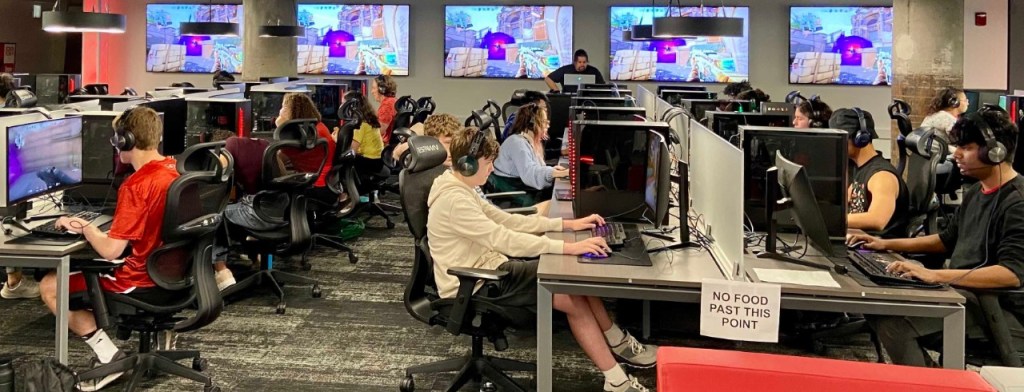
Cover Image Source: https://www.uc.edu/news/articles/2023/06/students-explore-game-development-cybersecurity-and-more.html
Update: Q&A
After writing this, I got a few questions that I think are reasonably-observed and deserve answers, so I’m tacking them on the bottom.
Q: Aren’t most of the games on your syllabus digital-only anyway? How does Sony’s decision make a difference?
A: The operational constraints described above dictate the current iteration of the course, so yes, I’ve had to focus on digital distribution because there’s no other choice. This isn’t just a Sony problem though, it’s an issue across the board. For example, I teach a class on game design that includes history. As I wrote, many students have never played Super Mario Bros. Do you know what I can’t reasonably assign as homework? Super Mario Bros.! I cannot guarantee that students have a Switch/Switch 2 (the only currently manufactured place it is distributed legally), and I can’t even hand them one of my NES carts because they’ve got no way to play it.
Q: Does the Steam PC Café Program solve your logistical issues?
A: It’s a nice but imperfect bandage for scenarios involving games that are distributed via Steam, but of course, not every game is. Additionally, it still requires students come to a specific lab space for a specific constrained time (when the lab tech is in to manage it) to do their homework, which is just not possible for many students. Some of them commute over an hour to get to school!

