Much has been said about the Game Developers Conference’s rebrand to “GDC Festival of Gaming.” Now that we’re on the other side of it, as somebody who was heavily involved in planning of events in and around this year’s conference, I wanted to write a recap of how things went, my thoughts, and what the future might hold.
I’ve broken this down by category of involvement, so you can jump around to the sections that interest you.
Table of Contents
General Observations
Independent Games Festival
Interactive Fiction Technology Foundation
IGDA Game Writing SIG
Miscellaneous Other Activities
General Observations
This year, as noted above, was one of transition. After last year’s conference showed that traditional big spenders (Epic/Unreal, Unity) were no longer going to be dumping money into exhibiting on the show floor, it was apparent that something had to change to avoid another show where it felt like everything was empty and dire (for a show floor impressions podcast from the 2025 expo, you can listen to Liz Ryerson, Ty Underwood, Max Kreiger and me on The Insert Credit Show).
And so change has come to GDC. The show floor was smaller – whereas in the past the show floor took up much of both North and South Moscone Center, this year the left side of North (as one descends the escalator) had been converted into an auditorium for the awards ceremonies, leaving the old awards space in Moscone West unused (to my knowledge, anyway). The expo floor being smaller meant the loss of the giant booths was less apparent in a photograph, as booths were bunched together into a smaller space, but there was less floor real estate overall.
For the first time ever, GDC set up picnic tables, food vendors in Yerba Buena, with live music. This received a mixed response; people were happy for access to the food (which was in general better than what one can get at the Metreon food court right next to the park) but for liability reasons, much of the park was fenced off to prevent vandalism to the cooking paraphernalia in the various food stalls. The fence layout was adjusted throughout the week to try and make the space less exclusionary in its appearance, but it was never going to be as nice as the big open field filled with people meeting, sitting on picnic blankets, holding meetups and other more free-form networking. The music was way too loud on the first day but after that was reduced to pleasant levels, but it also meant the space where Lost Levels takes place was occupied by the musicians. Overall, the takeover of Yerba Buena felt like a miss to me. It certainly cost the conference some sum to manage, and I get the feeling more people disliked it than enjoyed it. The food at Metreon is right there and there are plenty of other eateries within a block or so of Moscone.
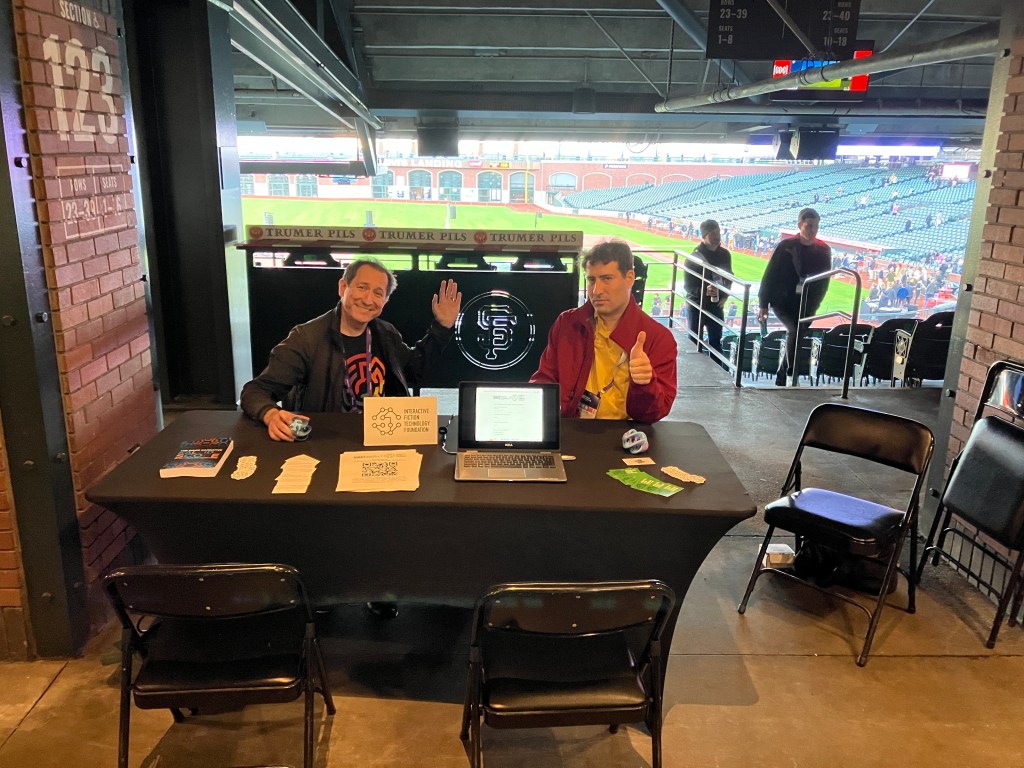
The second major new event was the Monday Night Opening, which took place at Oracle Stadium. This was cool for me, because I had a table to exhibit at (see below), and I had never been to Oracle Stadium, but it felt significantly under-attended. Oracle Stadium is a fifteen or twenty minute walk from Moscone and I think a lot of people didn’t feel it was worth making the hike just to watch Scott Pilgrim in the baseball stadium and eat overpriced stadium food (a friend told me his beer cost something like $22!) – another miss, and probably a costly one? I can’t imagine renting out the stadium is cheap! The speaker party also took place at the stadium, in the dugout. It was fun to go down in there as well, as a speaker, but the length of the speaker party was very short – it felt like people were being herded out too quickly. I’m guessing they didn’t want to keep the open bar all night.
The final big change I want to discuss is the “GDC Commons” floor space, which I participated in as an exhibitor, so will be covered below.
Independent Games Festival
My longest-running association with GDC is through the IGF, where I have served as a judge since 2016 (happy ten year judgeversary to me!) and as a juror in the Nuovo category since 2025. This year, my fellow Nuovo jurors were A.M. Darke, Allison Yang Jing, Jennifer Schneidereit, Joel Jordan, Noah Sasso and Pippin Barr. I love the IGF. For those who are unfamiliar with the process, here’s how it works.
The competition allows anybody to submit almost anything – a game can be finished, a demo, a scribble on paper, whatever. You can’t submit something that has already won or been nominated, of course.
There are two rounds – the Judge round and the Jury round. The Judge round is several hundred developers who have volunteered their time to try and sort through the hundreds (there are regularly upwards of 500 entries) of games that are submitted. Judges can talk with one another on a private message board about each entry, and make recommendations. You basically say “I think this game should be nominated for (check the box of the awards here).”
The Jury round follows the Judge round, and is conducted by small panels (about 7-10 people per category). The juries can see how the judges recommended things – so for example, if 80 judges said “I think Total Killer Kombat 2026 should win for Narrative this year,” the Narrative jurors will probably be taking a good hard look at that entry. The judge recommendations are just that though – recommendations – so the juries are not mandated to follow them. Historically there has been a good amount of discussion along the lines of “okay, here’s what the judges boosted; did anybody see anything else that may have been overlooked and we should consider?” With so many entries, there will always be things that slip through the cracks even with hundreds of judges, so this kind of due diligence is important.
When voting comes, the jurors each submit a secret ballot for their category, and for the grand prize (all jurors vote on Grand). You don’t get to know how any other juror voted in the end, nor do you know the winners until the awards ceremony.
The IGF is a lot of fun for me not only because I get to see what all of my indie peers have been working on, but also because of the comradery of discussing the work with friends (and then seeing them at the conference, of course). The judge and jury discussions are always really exciting, with lots of opinions about what makes good design, story, art, and so forth. It’s kind of like a big open forum to discuss the creative aspects of our profession, and I love that kind of thing.
As a Nuovo juror, my fellow jurors and I are tasked with selecting the game that best falls within the category description “abstract, shortform, and unconventional game development which advances the medium and the way we think about games.” What this translates to is weirdo art games and avant-garde digital experiences. Full disclosure: as a game writer, I would love to some day be on the Narrative jury, but I was told that because I sometimes make weirdo art games and avant-garde digital experiences, my expertise is more valuable here (there are just fewer people who do this kind of thing I guess?)
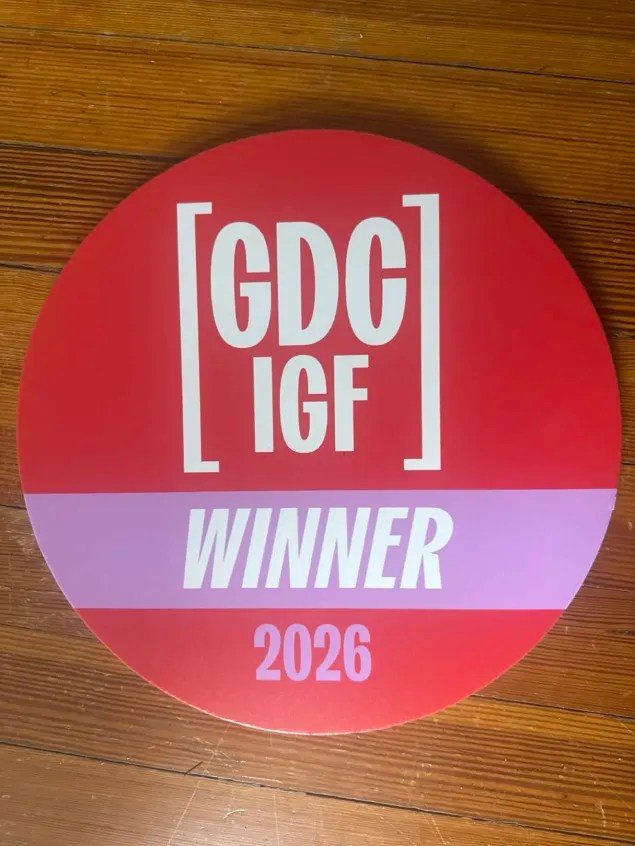
Anyway. This year’s winner was Horses, designed by Andrea Lucco Borlera and published by Santa Ragione. The game had a lot of controversy surrounding it, but that didn’t really play into the reasons why it won (I can’t talk about the specifics of jury conversations for confidentiality reasons). I wasn’t actually sure that it WOULD win, but I voted for it. I was under the impression that Titanium Court, which won grand prize, would also win Nuovo; I’d met the Santa Ragione folks on Monday and wished them luck and told them I was rooting for them but I honestly didn’t think it was gonna happen. Horses was my personal indie Game of the Year last year, but it didn’t seem to me like it found a huge audience.
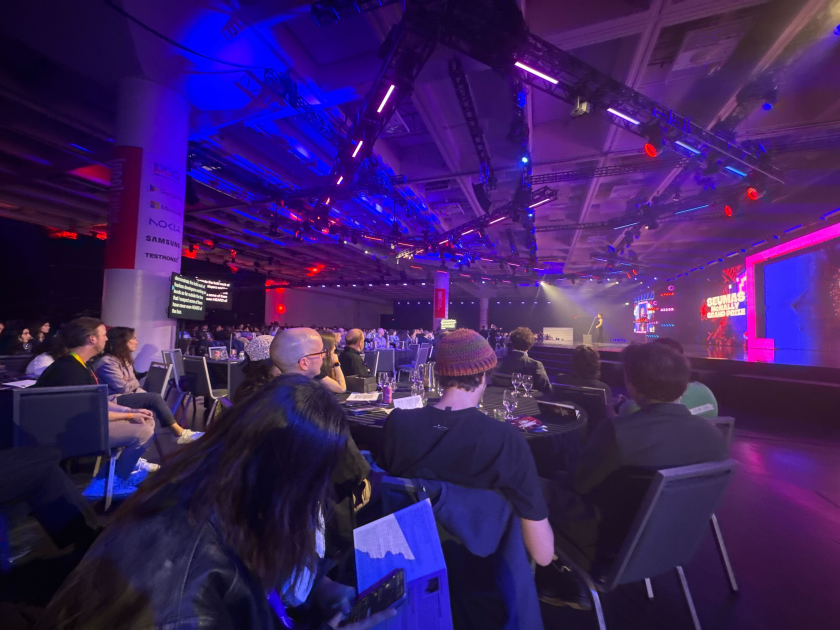
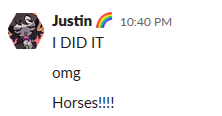
When Horses was announced as the winner, I was shocked. Here is my live reaction from the Allfather Productions Slack (where folks were watching the awards on the livestream):
Allison, who was sitting next to me, wrote on her copy of the awards show program “we are the kingmakers.” It was an incredible moment for the studio after all they went through with this game, and deserved – Horses uses a combination of cinematic techniques and historic filmic references to tell its story in a highly stylized, compelling fashion.
The IGF space on the show floor, on the other hand, was less great. It was at the far end of the hall and although it had alt.ctrl.gdc right next to it, it felt much emptier than prior years. Devs used to stand by their booths to meet and greet attendees, but this was really not the case this year – I think after seeing how low-traffic the area was, many of them decided to go use their time in a more constructive fashion. I was told that literally zero journalists showed up for the IGF “Press Hour.” We all know how games press is suffering right now, but this is pretty dire.
There is a second awards show, the Game Developer’s Choice Awards, which I did not attend. I did go to both shows’ afterparties, in a “speakeasy” behind the awards area. These were a lot of fun and good socializing in a quiet space, but they were again very short – nobody seemed ready to leave when we got ushered out. The open bar strikes again?
Interactive Fiction Technology Foundation
I have wanted to bring IFTF to GDC for some time, but wasn’t sure how to get space given our nonprofit budget of about seventeen dollars. In 2024, Frank Cifaldi and the Video Game History Foundation had space on the show floor for free, and so I asked him how he had made it happen. In a stroke of luck, GDC’s Conference Producer, Sam Warnke, happened to be standing right there, and he introduced us. It took about two years of slow back-and-forth, but this year IFTF was represented at GDC with a table at the Monday Opening Night event and three tables in GDC Commons.
I want to acknowledge the individuals from Informa with whom I worked this year: Sam Warnke, Ashley Corrigan and especially Jordan Stillman, who did amazing work making herself available around the clock by email, zoom and text to ensure everything with our project went off without any issues, that problems were addressed quickly, and questions answered immediately. The team did heroic work, at least from our vantage point.
So! I talked about Opening Night above, but what was GDC Commons? During my talks with Informa, I repeatedly emphasized two main points:
1) IFTF is an important pillar of the games industry, Twine is a critical piece of development infrastructure, we cannot pay GDC’s prices to be present but we SHOULD be.
2) IFTF is not the only nonprofit that is in this scenario, and space should ideally be given over to multiple other groups that serve the industry in valuable ways.
My advocacy for a “nonprofit zone” was apparently taken into account, as we were given space in an open area with groups like Black in Gaming, Foundation Games [4 Diversity], Boston Game Dev and more. GDC Commons was also home to the “Indie Arcade” (I think we were technically in this section) where devs were playtesting indie games, an interview stage, a lounge area and more. It was a good vibe with prime real estate, right next to the elevator as people reached the show floor.
We had three tables spanning two activities: GDC Twine Adventure, and the Visible Zorker. GDC Twine Adventure took up two of the tables, and was an exquisite corpse-style development experiment, where every person who came by could add a node to the unfolding branching story. One table allowed visitors to edit the game, the other allowed them to play the current build. We had something like 80 or 90 developers come and work on the game over the span of the three days the expo hall was open, and the project turned out great (if predictably incoherent). The game will be public soon, when it is I will update this post with a link to play it.
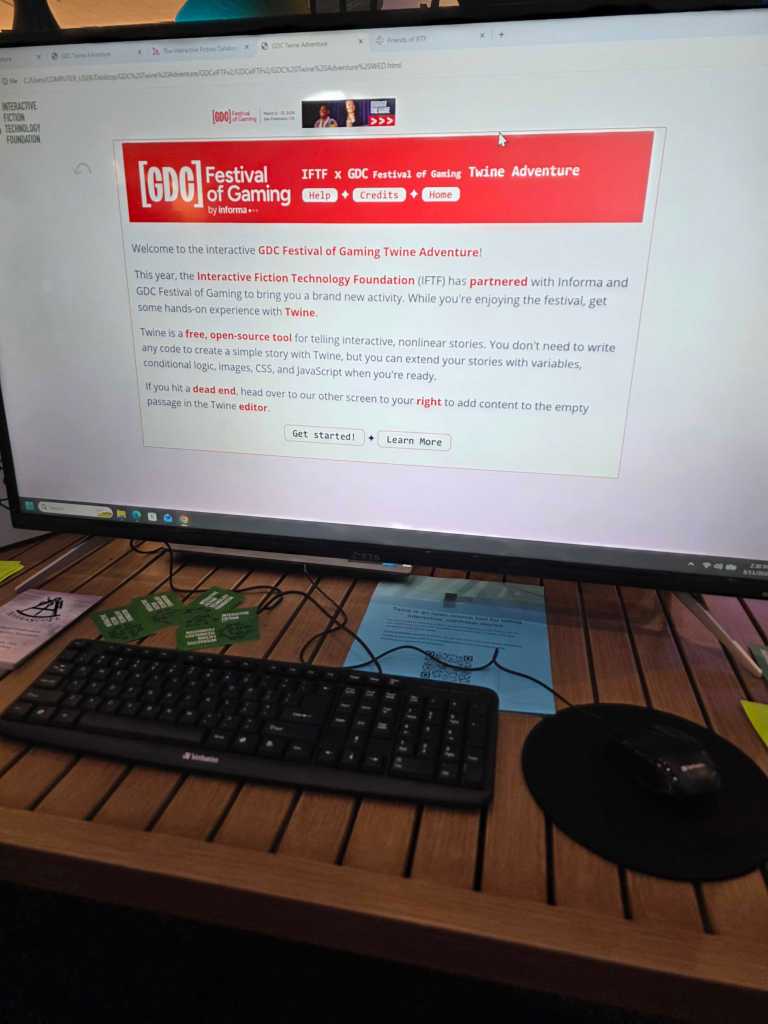
The Game Build in playable form (photo by Grim Baccaris)
The third table displayed Andrew Plotkin’s Visible Zorker, which allowed attendees to play Zork, Zork II, and Zork III with the ability to watch the game code load and execute in real-time, as well as providing information on state, variables, tracked timers, a map, and more. Andrew has his own write-up about the Zorker at GDC on his blog, so please feel free to check it out for full details.
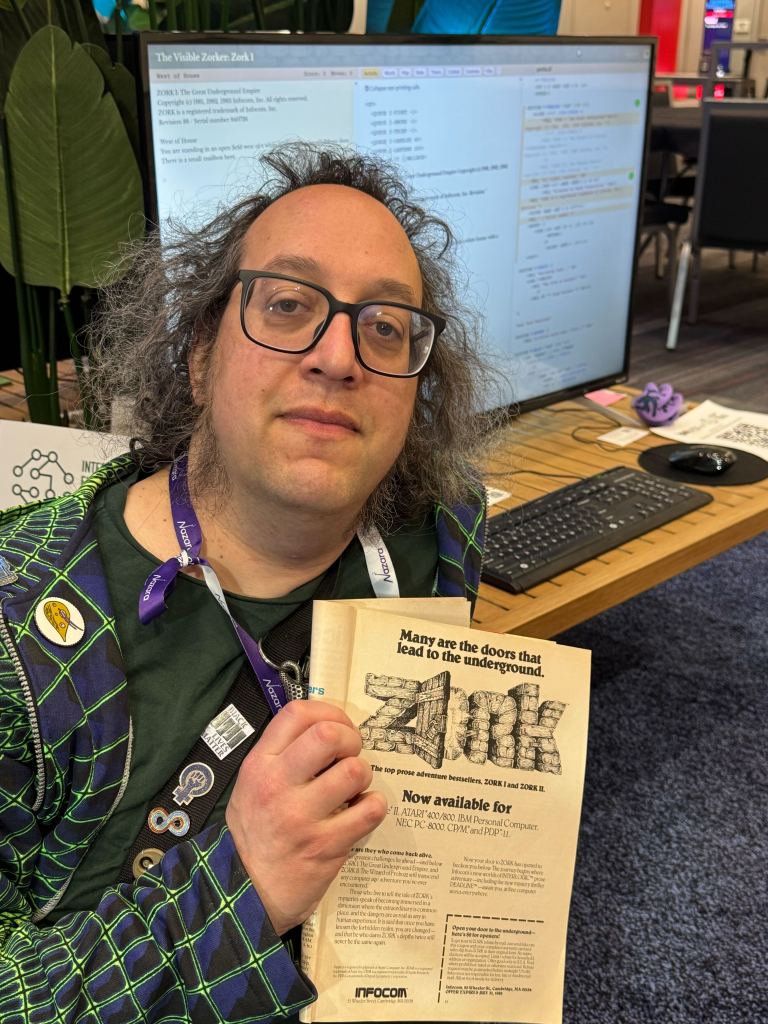
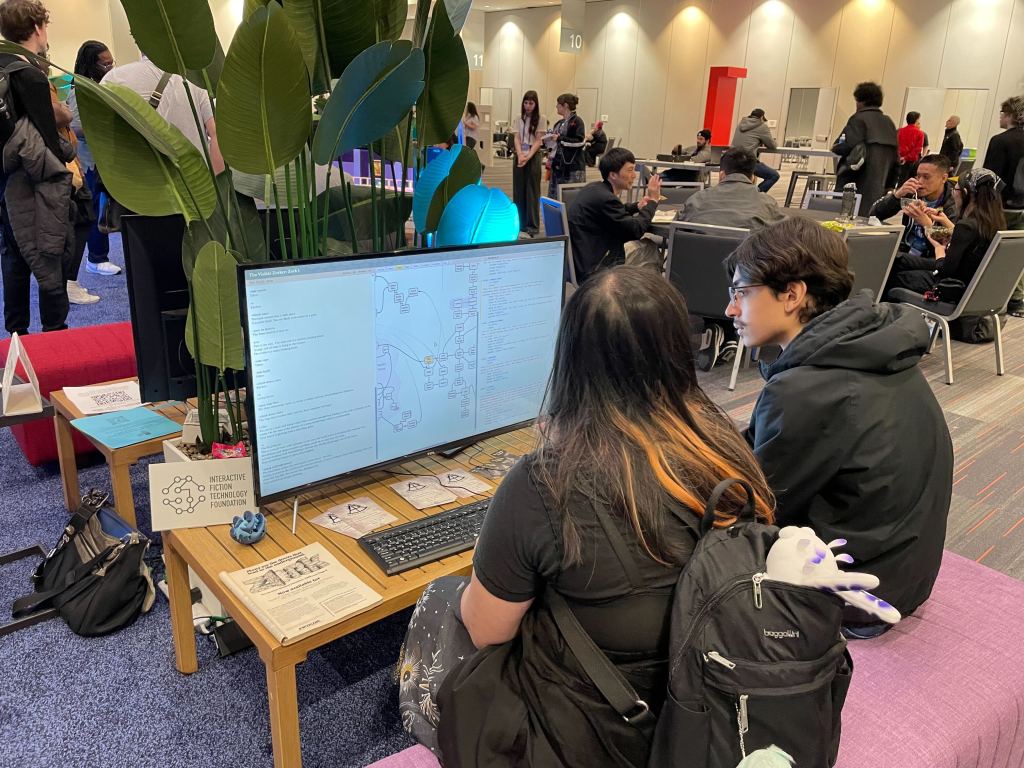
Overall, this year felt like a huge success. We were able to keep the booth staffed full-time with a cohort of volunteers, and also ran a successful scholarship program which gave out festival passes to members of our community.
IGDA Game Writing SIG
Last year, I got the ball rolling to rebuild and reinvigorate the somewhat-dormant Game Writing Special Interest Group. This has been a resounding success, with a new constitution, governing committee, website and presence at the event. In January, I was elected to a three-year term as the SIG’s Executive Chair. You can look at the Game Writing homepage for what we’re working on.
At GDC, we had a huge number of events – a frankly exhausting number of events! We raised something along the lines of $10,000 to run everything via a combination of ticketed events and institutional sponsors. You can read the full schedule for our events here, but I want to highlight a few.
The first event I want to speak about is the annual Game Writer’s dinner, which was held Tuesday night in our traditional location, Fang. Fang is great. The food is great. People talk about the garlic broccoli for a year afterwords. This is not a joke. The tickets to attend were $90/head which felt obscene, but that’s San Francisco. This was our biggest event ever, selling out the full 45 person event – next year I’ll need to raise the cap again. Getting loads of writers in one room in a way where conversation can actually happen is never not amazing. Trivia fact: this event is one borne entirely of spite. I was told in 2017 or so that Tom Francis (who is a very nice guy, I have nothing against Tom) had a dinner for indie developers every year, which was an exclusive invite-only affair. I’ve never been invited! So I said, “I can have my own dinner instead! Who needs Tom?” and thus the writer’s dinner was born. Anyway, Tom, if you’re reading this, please feel free to come to the dinner some time.
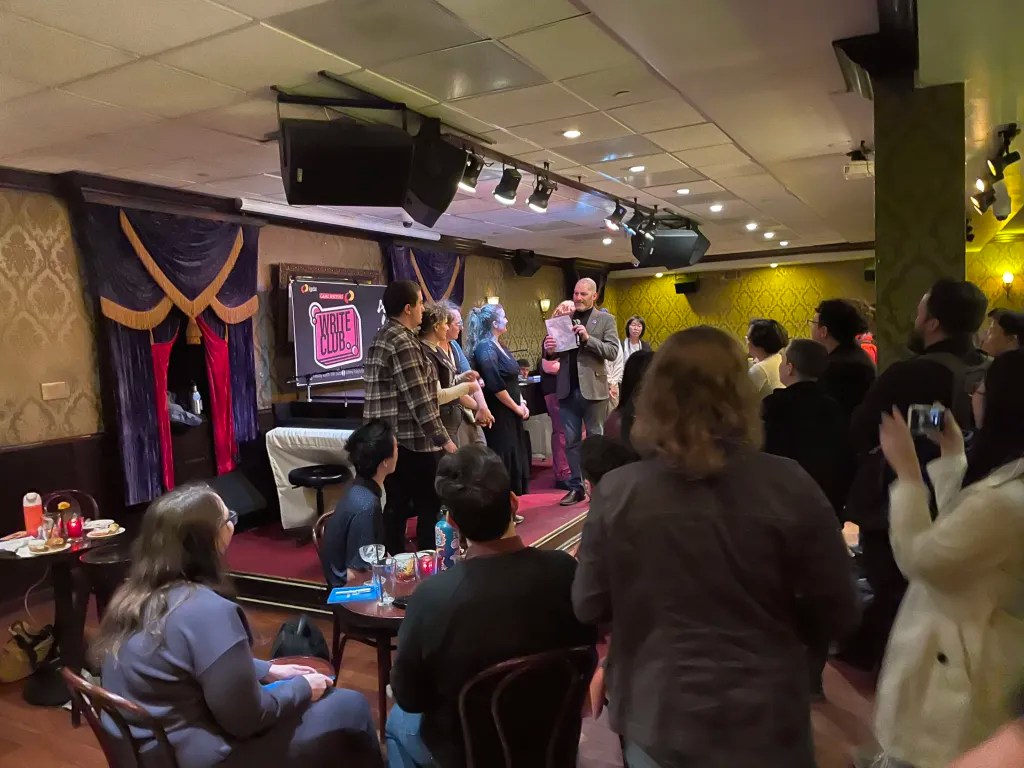
The second event was the biggest, our annual Write Club competition. Due to various circumstances, we moved from our historic venue at the Golden Gate Taproom to a new location, Johnny Foley’s Irish House. It was, for the most part, a great event – we had to turn numerous people away at the door because we hit capacity. Write Club is a SIG tradition started by Richard Dansky, where contestants are given a short period to write answers to ridiculous game-related scenarios. One of my favorite prompts this year involved writing a description for a single room in the smash-hit children’s puzzle game, Bluey Prince.
The final event I want to discuss is my roundtable session, Professional Game Writing Roundtable: Best Practices and Issues, which I co-hosted with Jon Myers. We had polled what people were most concerned about ahead of time (it was, unsurprisingly, AI) but discovered that people didn’t actually want to TALK about AI very much – they’d all basically made up their minds one way or the other and weren’t interested in hearing anything further. So we had a short chat about the state of things in that regard (bad, mostly – lots of venting) and moved on to other useful things, like what are the best tools to use for various writing scenarios (Twine and Ink were the most consistent favorites) and what the biggest needs for writers in the industry are right now (employment, mentorship). We also held an “Active Membership Chat” about the state of the SIG earlier in the week, and between these two events we ended up with a good roadmap about the kinds of professional assistance and thought leadership the SIG can work toward over the next year. I will note that these events were hugely attended – one side effect of “everybody can go to every talk” is that a lot of people show up to talks! More than the organizers expected in many cases.
Miscellaneous Other Notes and Thoughts
I went to lunch on Thursday with staff from publisher Fellow Traveller, with whom What Pumpkin have worked in the past. Also at the lunch were (newly-minted IGF grand prize winner) AP Thompson, Sunset Visitor’s Remy Siu and Nhi Do, some of my co-developers from What Pumpkin, and an ex-Telltale gentleman whose name totally escapes me. Sorry guy! If you read this email me and I’ll put your name in here. It was nice to catch up with Remy after our panel together at Worldcon last summer. We ate at Kin Khao, which is a Michelin-starred Thai restaurant that blessedly lets one just order what they want instead of forcing a tasting menu on you. I had khao soi which was very tasty.
Running between SIG events, the IFTF booth, talks and other meetings made this by far the most hectic and in a way, the least fun GDC. It was very fulfilling and satisfying to see so many plates remain spinning, and to help so many other people get to GDC, make connections, advance their craft, and more. But it was also exhausting in a way GDC has never been for me – I always come for work, but this year it really WAS work!
San Fransisco remains very expensive. I would be unable to attend if not for a free pass provided by the event as an exhibitor (and as an IGF judge/juror,) the travel assistance provided to me by the University of Cincinnati, and the ability to stay for free with a friend. I hear Moscone Center’s contract with GDC expires in 2030, and I would strongly recommend they get the heck out of San Francisco for literally any other city in the country. It is still absolutely worth going if you can find the budget or means to do so, especially for young career-seekers, students and junior developers. The connections you make here are better than most other places in this industry. But that doesn’t mean that the price situation is acceptable!
 Justin Bortnick